THE ROOFERS WHO CALL YOU BACK
Commercial roofing in St. Louis
A free roof inspection with a written photo condition report: repair, restore or replace. St. Louis Roofing & Exteriors roofs commercial buildings in St. Louis: offices, warehouses, churches, schools, HOAs and apartments, in TPO, EPDM, metal or a coating, with a written scope.
Request a free inspection Call (314) 244-3799
Leave us a message anytime.

Who we roof for
Commercial roofing in St. Louis is mostly low-slope work on buildings that stay open while the roof is done. A church, a warehouse, a school, an apartment community and a retail or office building do not share one roof, and they do not share one way of deciding. A board wants a scope it can compare. A property manager wants each building documented on its own. A facility lead wants the work phased so the people inside can keep using the building.
We roof for those building owners. The pages below are the building types we already write about. Retail and office roofs are scoped the same way when there is no separate page for them: walk the roof, photograph what it shows, and price the work in an itemized bid.
This page does not name a client. The past jobs we publish are on their own pages, by building type and city, and the commercial ones are linked further down. The useful part here is how the work is organized, which system goes on which roof, and when a repair is the honest answer instead of a replacement.
Roof systems we install
Crews install TPO, EPDM, roof coatings and metal roofs. Modified bitumen is still on a lot of older St. Louis roofs, and we repair and replace that membrane when it is the roof the building already has. We do not publish a list of systems we do not install.
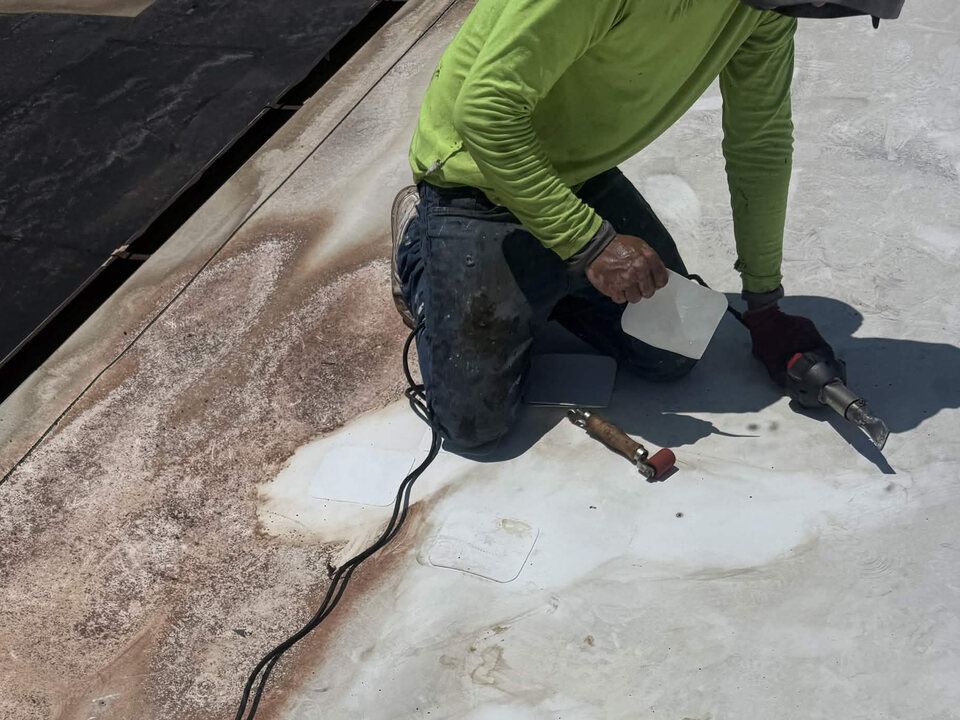
TPO is a thermoplastic membrane. Seams are heat-welded, and the sheet is usually light colored, which matters on a low-slope roof through a St. Louis summer. EPDM is a synthetic rubber sheet. It is often black, and its seams are joined with tape or adhesive rather than a weld. The two are not interchangeable on a whim. The deck, the insulation, the edge details and how the building is used decide which one belongs in the bid. Both are written up on their own page.
A roof coating is not a new membrane. It is a restoration layer for a roof that is still attached and dry. When the insulation is wet or the deck has failed, a coating is the wrong product, and the honest bid is a replacement. Metal is its own system, standing seam or exposed fastener, on houses and on commercial buildings. Each of those has a page so a building owner can read the system before asking for a scope.
Commercial roofs we have worked on
Past commercial jobs, each with the photos from the roof, named by building type and city.
Replacement and repair
Replacement and repair are different jobs, and they should not be written as if they were the same bid with a different total. A replacement tears off or recovers a roof that is used up. A repair fixes the places that have failed and leaves the rest. We decide by what the roof shows: open a test cut when the insulation might be wet, look at the seams, the flashings and the drains, and say so when a patch would only move the leak.
A full commercial replacement, tear-off or recover, is its own page, including how the work is planned around tenants. Active leaks, seam repairs and the day-to-day repair of a commercial roof are handled as repair work. That repair lives on the repair site, including commercial roof repair and flat roof repair, so this page does not compete with it for the same job.
Building owners who already know they need a new roof can start on the replacement page. Building owners who have a leak and want it found first should start with the repair site. If the repair visit shows the roof is finished, the written scope says that, and replacement is a separate proposal.
Work on an occupied building
Most commercial roofs are replaced while the building is in use. A sanctuary still has services. A warehouse still ships. A school still has a weekday. The roof work has to be planned around that, not the other way around.
Before the tear-off starts we agree the phase: which section of the roof comes off first, where the dumpsters and the material sit, which doors stay clear, and what the people inside will hear. Tear-off is the loud part. Welding and flashing are quieter. Splitting those, and stopping at the end of the day with the open roof closed up, is how an occupied building stays usable.
Tenant and occupant notices are part of the plan when the building has more than one user. We do not surprise a tenant with an open roof over a stockroom. Safety on the ground matters as much as safety on the roof: secured ladders, marked walkways, and a daily cleanup so fasteners and scrap are not left where people walk. The sequence is in the scope. It is not improvised from the parking lot on the first morning.
- Phasing agreed before tear-off, so the building can stay open
- Notices for tenants and occupants when more than one group uses the building
- Daily cleanup, secured access and a roof that is closed up at the end of the day
Documentation for owners and boards
A commercial bid is read by people who were not on the roof. A board, a property manager or an owner needs the same pictures and the same words we used to decide. That is the paperwork: a photo record of what we found, an itemized scope of what we propose, and a closeout that says what was done.
The photo record is not a brochure. It is drains, seams, wet areas, failed flashings and the deck where we opened it. The bid lists tear-off or recover, the membrane, the insulation, the edge metal and the flashings as separate lines, so two proposals can be compared without guessing what was left out. A lump sum with no scope is not something a board can vote on.
A certificate of insurance is available on request for the building owner or the property manager who needs it before a contractor is allowed on the roof. We pull the permit on every job that requires one. Which office issues it depends on the address. We do not describe a permit rule we have not read.
- How we inspect a roof
- The roof inspection is free.
- Hail and storm damage
- Winter roof prep and ice dams
Information for building owners
The warranty we state ourselves is a written labor and workmanship warranty. The term is on the certificate for that job, and the same statement is on the insurance and credentials page. A full roof replacement is not the same term as a repair or a roof layover. We do not restate manufacturer system-warranty terms on this page. Those terms belong to the manufacturer, and we do not publish them until they are the terms we can actually hand a building owner.
What a building owner can compare in a bid is simpler than a warranty brochure. Who is warranting the labor, for how long, in writing, and what is excluded because it was never in the scope. A workmanship warranty does not turn a ponding roof into a dry one if the drainage was left out of the bid. The scope and the warranty have to describe the same roof.
Where this work is done
The work on this page is on the Missouri side of St. Louis. The areas are the ones this site already publishes, in the same order, on the block below. We do not add a county here by naming it in a sentence, and we do not cross the river. If a building is outside those areas, we say so.
Heat, hail and ponding are the three conditions that show up on almost every commercial roof we look at here. Summers are hot enough that a dark, unshaded membrane runs hard. Hail finds the ridges, the metal edges and any brittle coating. Ponding, water still standing long after the rain, is the one that quietly ruins seams and insulation. A replacement that does not fix the slope or the drains will pond again. That is a drainage problem, not a membrane brand problem.
- Heat on a low-slope roof, hail on edges and seams, and ponding where the drains do not keep up
- Drainage corrected in the scope when water is living on the roof
Questions building owners ask
- Do you work for building owners, or only for houses?
- Both. This page is the commercial work: low-slope and flat roofs on buildings that are in use, scoped for a building owner, a board or a property manager.
- Which flat-roof systems do you install?
- TPO, EPDM, roof coatings and metal. We also repair and replace modified bitumen where that is the membrane already on the building. The TPO and EPDM page explains how those two membranes differ.
- Repair or replace — how do you decide?
- By what the roof shows. A limited failure on a dry roof can be repaired. Wet insulation, a failed deck or a membrane that has already been covered over usually means replacement. The repair visit is a separate page on the repair site.
- Can you work around an operating business?
- Yes. Phasing, staging, tenant notices and daily cleanup are agreed before the tear-off starts so the building can stay open. We do not promise a clock time for the work.
- What should a board compare in the bids?
- The same scope, written in lines: tear-off or recover, membrane, insulation, edges, flashings and drainage. A single number with no lines is not comparable. The replacement page has a longer checklist.
- Will you give us photos and a certificate of insurance?
- Photos of what we found are part of the inspection and the closeout. A certificate of insurance is available on request. We pull the permit on every job that requires one.
- Do you publish a manufacturer warranty term?
- No. The warranty we state is our written workmanship warranty, and the term is on the certificate for the job. Manufacturer system terms are not restated on this page.
- Do you pull the permits?
- Yes. We pull the permit on every job that requires one. Which office issues it depends on the city or county, and the service-area pages show it wherever we have the official answer.
Commercial areas and the buyer's guide
What you can check
- Founded 2004
- GAF Certified
- BBB Accredited, rated A+, accredited since 9/25/2015
- Google rating 4.8 from 252 reviews
- Insured: general liability, workers' compensation, commercial auto and umbrella (excess liability) coverage. Certificate of insurance available on request.
- We pull the permit on every job that requires one.
- A written labor and workmanship warranty: 5 years on full roof replacements, siding or gutter jobs, and 3 months on repairs and roof layovers, with the details on your warranty certificate.
- Inspections documented with photos of what we found.
- The roof inspection is free.
Where we do this work
- Jefferson County
- St. Louis City
- St. Louis County
- St. Charles County